Untamed Land

Untamed Land
Untamed Land

Saturday, November 17, 2012

Maggie goes to Sri Lanka

Maggie is another longtime friend of mine from my Arizona years. She currently teaches school in Oman, (Persian Gulf). Before that, she taught school in Quito, Ecuador. I met her when she was teaching art at Alchesay High School on the White Mountain Apache Reservation. That was sometime around 1989.
She just got back from a vacation to Sri Lanka, which is an island nation off the southeast tip of India.
While she was in Sri Lanka, she was able to visit a couple of nice nature reserves, Ella, and Uda Walawa National Park. She got some excellent opportunities to photograph wild Asiatic Elephants.
Can you see that there are two baby elephants in this photo?

She managed to see some really great wild critters, like this very impressive, Crested Hawk-eagle.

Another very impressive bird, Crested Serpent Eagle. It does not have a very impressive crest, but what a great photo. I only managed to get the briefest glimpse of one of these in Thailand. As the name suggests, they specialize in eating snakes and other reptiles.
Standoff with a Golden Jackal. I don't know if this is the same species called Golden Jackal in Africa.
A Peacock in all its glory. Wow.

Another great shot.

A Spotted Deer feeding her hungry fawn. As I understand it, there are no tigers on Sri Lanka. I believe that leopards are the top predators of the Spotted Deer.
The national birds, Sri Lankan Red Junglefowl. Talk about funky chickens, these have very distinctive combs.
Water Buffalo cooling off in a favorite wallow. Now that is the life.

A really fine shot of a White-browed Fantail Flycatcher. Maggie saw some really neat stuff in a short amount of time. Sri Lanka is yet another country that I would love to visit also.

Saturday, November 10, 2012

I Wish I Was Dead

No, I don't really mean that. I'm not even all that depressed, just weighed down by the thought of another endless winter, and I'm too broke to get away to someplace warm. Gary and Tom are going back to South Africa, and they have a space for me. Unfortunately I cannot afford the trip, nor get the time off from work.
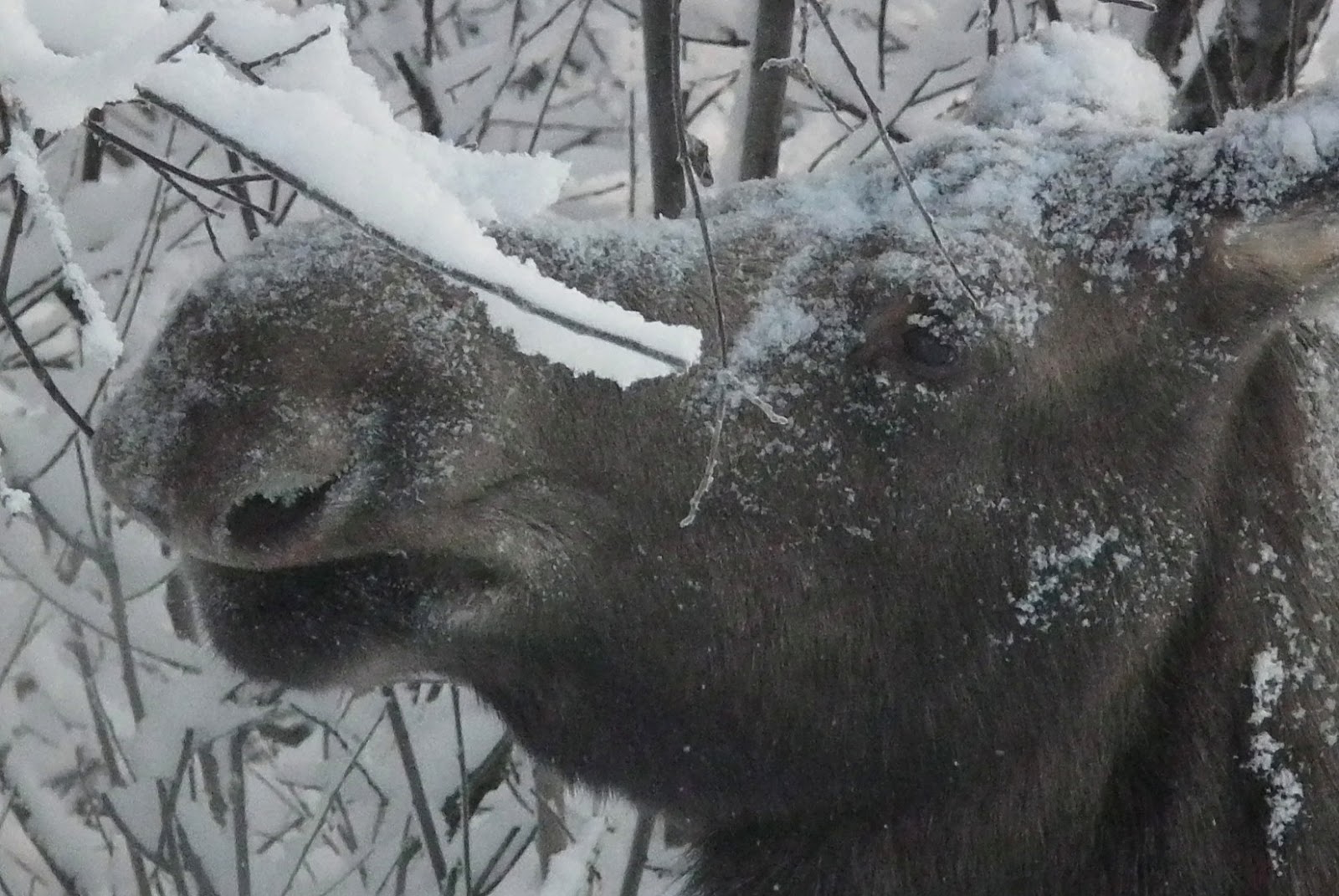
At least I don't have it as bad as this Moose. It will be lucky to survive the season at all.
Winter can be a lonely, and depressing time. I go to work in the dark, work all day in a windowless cubicle, and come home in the dark. On weekends I get to see some daylight.
Young people who grow up around here adapt to the weather much better than wimps like me who grew up in Southern California. The temperature was in the teens when I shot this photo. Shorts and t-shirt weather for some of these youngsters. As I go to work, I pass by groups of school children waiting for the bus. There are always several of them, (boys always) who are too macho to wear a coat.
Cabin fever, anyone? Being outdoors, even on the gloomiest of days can help to brighten up one's attitude.

There are natural ornaments on the trees of winter to lighten a heavy heart.
Some of them are not safe to loiter underneath for too long.
Red foxes, and some other opportunists, do just fine in harsh weather. I wish I could think like a fox.This painting from a few years back expresses my feelings about the newly arrived cold season. It's just something that has to be endured. That does'nt mean I can't whine about it from time to time.

Saturday, November 3, 2012

The White Mountains of Arizona

Check out this wonderful photo of a Long-tailed Weasel. My old friend Richard Inman just sent this to me. It was taken on the White Mountain Apache Reservation. Richard worked there for many years with the BLM, or BIA, I forget which.
Richard also got this nice close up of a tiny, Western Chorus Frog, or Mountain Treefrog. I'm not sure which it is. Anyway, I lived in the White Mountains for 19 years before moving to Alaska. Richard and Jody Inman became good friends. I fondly remember many trips we took together, and many wonderful dinners at their house. Jody bakes the best cookies ever, healthy too.
Alaska is known for it's abundance of Bald Eagles. They are common in parts of AZ as well.  They winter in the White Mountains.

A prominant geographical feature of the White Mountains is the dramatic drop-off of the Mogollon Rim. Here Richard photographed a snag full of Ravens just below the lip of the rim. My house was about a quarter mile from the rim. I used to walk over to the Mogollon Rim Overlook several times a week.
AZ has big, magnificent Swallowtail Butterflies that are about four times bigger than the puny, and uncommon swallowtails around here. They seem to congregate at iris flowers.
Most people like butterflies a lot more than they like tarantulas. I really like them both. Every autumn is a good time to see tarantulas in the WM. The smaller males, like this one that Richard photographed above, become very active at this time of year.
Sometimes large numbers of males can be seen crossing the highway between Show Low, and Snowflake. They all die shortly after breeding, while the large females live on. None of them ever tried to bite me, with the exception of a pugnacious tarantula in Ecuador.
This is not the White Mountains, it is of course, the Grand Canyon. It lies about 150 miles northwest of the WM. The grand Canyon is pretty much my favorite place on earth. I fantasize that after I die, my soul will sail over the formations, and haunt the lonely side canyons. At least until I find an even better paradise.
This is not the Grand Canyon. It is the White Mountains. I bet that most of you had no idea that country like this existed in Arizona. It does, and it covers a large area in eastern/ central AZ. It abounds in wildlife, including the world's largest Elk.
So here are Jody and Richard, and a friendly wolf. Richard is also an enthusiastic collector of fine Persian rugs. Jody really likes to dote on her grandchildren. They actively travel to the natural areas in the western US.

Wednesday, October 31, 2012

Jeremy's Yard Birds

Petersburg is on Kupreanof Island in Southeast Alaska. It is truly an isolated place. He commonly sees whales, seals, and many seabirds right in front of his house, which faces Frederick Sound. Like these two very striking duck species. A male Surf Scoter, and two male Harlequin Ducks.
Surf Scoters are pretty much found exclusively on the ocean. Jeremy also sees, White-winged, and Black Scoters.
Barrow's Goldeneyes spend the winter on the ocean also. They are recent arrivals to Jeremy's neck of the woods.
Sometimes they can be confiding around people.
A species that is not easy to approach, Long-tailed Ducks. So far, they have not come close to shore at Jeremy's house.
Jeremy shot a series of photos of this Glaucous-winged Gull dive bombing some Red-breasted Mergansers.
Jeremy said that the gull zeroed in on one merganser, and was relentless in harrassing it. He thought maybe the gull was trying to get it's fish. I think the gull was trying to kill the hapless duck.
I once watched a group of gulls drown a Ruddy duck, and carry it off, presumably to eat.

Since it's Halloween night as I write this, I'll include this double exposure of Jeremy being Jeckyl and Hyde.  BOO.

Friday, October 26, 2012

An Owl, An Otter, and Whatnot

Anchorage has had two snowfalls so far this season. However the weather has been warm enough that the snow has all melted, except in the mountains. We have had about a week of glorious sunshine, but the overnight temps have been down into the single digits. The water is pretty much all frozen over and most all of the migratory birds are now gone south.
The locals, like this Steller's Jay, are pretty quiet these days. So I'm going to revisit a few of the highlights from last winter.

Pine Grosbeaks are much more conspicuous during the winter when they form flocks and visit bird feeders, and especially Mountain Ash trees.
Do you remember when I posted a few photos of this Saw-whet Owl and Red squirrel from last winter? I posted photos very similar to this one.
The owl never reacted to the curious squirrel. It spent the day in someone's yard near mine and was gone the next day.
I also posted a few photos of this curious Sea Otter from the trip I made to Seward last Feb. It was my best birding day of the year. I got two lifers on that day, Gray-crowned Rosy Finch and Yellow-billed Loon. More about them when I do my top ten bird list in early January.
All of my previous Sea Otter photos were shot from a rocking boat on choppy seas. This time, the sea was calm and I was on a stone jetty with a very cooperative subject.

The only way I could have gotten better photos was if I had a professional level camera and lens. Us po folks just got to make do with what we have.

Thursday, October 18, 2012

More Photos From Jeremy

Jeremy sent me some new photos from Petersburg. The Glaucous-winged Gull is obvious. Can you see the other birds in the photo? They look very much like the rocks that is their preferred habitat.
These birds are Black Turnstones, busily bathing at the water's edge. I am jealous because I have no photos of Black Turnstones at all. There is another shorebird in the photo, see it?

The mystery bird is the pale gray one in the center. Any guesses as to what it may be?

A closer shot. It's a Surfbird in winter plummage. Surfbirds and Black Turnstones share an almost identical breeding range and habitat preference. I have seen wintering Surfbirds in Mexico and as far south as Southern Peru. They are generally much more confiding around people than Black Turnstones.

Black Turnstones are close relatives of the better known Ruddy Turnstone. Whereas the Ruddy Turnstone is basically a pan world species, Black Turnstones are restricted to the west coast of North America. I'm not sure whether they occur in the Eastern Palearctic, like the coast of Siberia, Japan etc. I have also seen them in Northern Mexico in the winter. Ruddy Turnstones also share the same habitat along rhe West coast.