Untamed Land

Untamed Land
Untamed Land

Wednesday, November 17, 2010

Bosque del Apache

Bosque del Apache, (Apache Grove), in western New Mexico is a spectacular wildlife refuge. It is located near the desert town of Socorro. Birders know all about it because it is the wintering spot of many waterfowl. In the above photo, thousands of Snow Geese are taking wing at dawn to disperse to the surrounding corn fields.
Snow Geese, Ross' Geese, and many other species can be seen in the winter months. I have heard that the Summertime in Bosque is almost too hot and smelly to endure. The Rio Grande River supplies water to these natural wetlands.
Many birders and photographers converge on the wetlands at the same time that the birds arrive. There is a big waterfowl festival held there every November. These photos are fuzzy because they are second generation copies of 35mm slides.
Along with the Snow Geese, large numbers of Sandhill Cranes also create noise pollution at the marsh. The sound can be near deafening at times. There are two white, Whooping Cranes in this photo that contribute their fair share to the cacophony. Whooping Cranes are critically endangered, but their populations are slowly increasing thanks to a lot of effort and money by concerned public and private organizations.
This photo is a little dark because I was trying to tone down the harsh contrast of the bright day.

Local farmers are paid to plant corn just for the birds. Both Snow Geese and Sandhill Cranes prefer to forage in plowed under fields.

Rio Grande Turkeys are common, and confident, in the refuge.
There are many smaller desert birds in the refuge as well. This is the only place where I have seen Crissal Thrashers.
It's a good place to see wintering sparrows like this striking, Black-throated Sparrow.
There are many raptors including eagles, hawks, and falcons like Peregrines and this Kestrel.
It looks like sunset, but it's sunrise on Bosque.
That view is worth a second look.

Friday, November 12, 2010

Galapagos For Skinflints Plus Another Painting

Isla de la Plata is touted as 'The Poor Man's Galapagos'. It is an island about 10 miles offshore form Puerto Lopez. Virtually every tourist who ventures to PL, goes there to visit Isla de la Plata, (silver island).
Boat tours to the island depart every day. I paid $40.oo for a day long tour with 5 other tourists. We were treated very well on the tour that included endless snacks, non-alchoholic drinks, and lunch. We landed on the island, hiked up to see nesting seabirds on the cliffs, and were taken to a cove for some snorkeling.
I was an avid snorkeler in my youth but over time I have mostly lost interest in the sport. This time I relaxed on the boat while the others got wet. From the boat I saw everything they saw.
It was a brutally hot day and a long, steep climb to the nesting seabirds. I told the guides that I would stick to the beach while the other gluttons for punishment trudged uphill. This crab was on the rocky shore.

There were plenty of birds to see right on the beach. This is a Blue-footed Booby.

These Boobies had absolutely no fear of people.
This is my favorite photograph of the trip.
There was some good scrub habitat behind the beach. There were some small lizards and many small birds in the bushes, including this Long-tailed Mockingbird.
The new birds I saw on the island were Red-footed and Nazca Boobies, and this Collared Warbling Finch. Of course the island was not nearly as good as the Galapagos, but it was certainly worth the $40.oo it cost to get there. I dont remember the name of the tour company but they went above and beyond for their clients. This was not the end of my trip to Ecuador. I saw more good new birds but my camera died so I have no more photos to show. Ecuador is definitely worth an encore visit.
This is not from Isla de la Plata. It is a painting of Alaska Seabirds, Tufted Puffins. Called, Highrise Housing, 16x12" I have sold every puffin painting that I have done. I hope this one is no exception.

Wednesday, November 10, 2010

Funky Puerto Lopez

I'm no beachbum, even though I spent a good deal oy my youth on the beach. Laying around and working on my tan is not for me. I went to Puerto Lopez for one reason, Isla de La Plata, (The Poor Man's Galapagos). That will be the subject of the final report of my Ecuador trip. This post is about Puerto Lopez itself.
Ecuador is very green. The bus ride from Guayaquil passed through some verdant countryside that gradually became drier as we dropped down to the coast. The area around Puerto Lopez was very desert-like. It was hot and dusty.
The small town of Puerto Lopez. Like Guayaquil, PL was oppressively hot. I sweat so much that my camera malfunctioned because of the constant sweat pouring off my body. This heat prevented me from exploring the hills around town. It was just too hot to endure for a boy from Alaska. There was an interesting nature reserve nearby that I wanted to visit but I was unable to carry enough water needed to get me through the reserve.
A friend of mine visited the place at a different time of year and reported that it was uncomfortably cool, but she is a wimp about cold temperatures. I hope she is not mad if she reads this.
This is the busiest intersection in town. There are several hotels and restaurants that cater to tourists but fishing is the main industry of the community. I paid about $4.80 for my hotel room. It would have been $5.00 if I wanted a room with a television. The place is quiet and friendly. I loved the vibe of the place even though there was little to do.
Life on the beach.
These fishermen attracted a crowd of admirerers hoping for a handout.
The main activity of the day happens in the morning when the town's fishermen return with their catch. While they clean fish, Magnificent Frigatebirds patrol for discarded fish guts. They are huge birds.

It was discouraging to see how casually these Marlins were hacked to pieces along with every other fish.

Down the beach a ways some Black Vultures were scavanging the carcass of a sea turtle.
A common bird around town, Long-tailed Mockingbird.
Croaking Ground Doves were also common, even on the beach.
The most colorful birds were the male Vermilion Flycatchers which occur from the Southwestern US down into Western South America. Even on the Galapagos.
Fasciated Wrens are one of the larger species of Wren.
I had some excellent meals during my stay in Puerto Lopez. It is well worth a return visit.

Sunday, November 7, 2010

Guayaquil and a New Painting

The Ecuador adventure continued for Gary and I but we parted ways after the Amazon. Gary had to leave earlier than I did and decided to spend the last part of his trip in the Galapagos. I was tempted to go there as well, but it's so expensive to get there, and I figured I could see more new species by staying on the mainland.
After the Amazon I took some very long bus rides all the way across the country to the West Coast of Ecuador. First I went to Ecuador's largest city, Guayaquil, and decided to visit several protected areas nearby. I visited several recommended local agencies to see if they could make the arrangements for me. All of them, except one, only wanted to organize trips to the Amazon, or the Galapagos Islands. The one place that was willing to help me get to local nature reserves kept telling me to come back tomorrow.
Guayaquil has the reputation for being a dangerous place to visit because of the high crime rate. Even the local people on the street kept stopping me and asking, "dont you know that it's dangerous for you to be on the street?". There were no other tourists around, but no one tried to rob me either.
The one thing that bothered me about the place was the oppressive heat. Way hotter than the Amazon.
While I was sauntering along one of the main boulevards, I saw these swallows nesting on an old colonial building. To me they looked like Bank Swallows,(Sand Martins), but those guys nest in holes. It turns out they were a new species for me, Chestnut-collared Swallows.
Another new species I saw in downtown Guayaquil, ( and one of my favorites of the trip), was the Pacific Hornero. It ran around on the ground behaving like a short tailed roadrunner. It was fearless of people, but would not stay still for a photo.
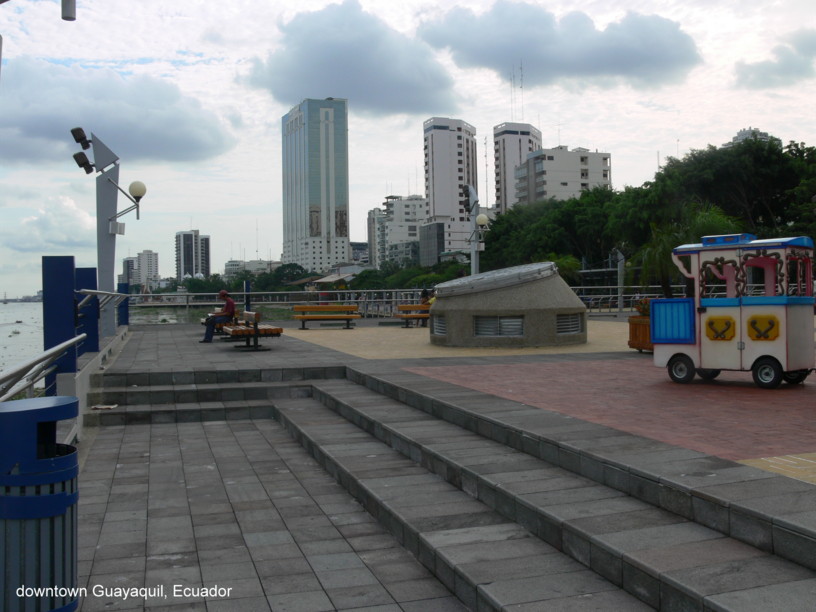
Not a new species, but a familiar bird of the neotropics, Blue-gray Tanager. It was found in just about the only nice part of Guayaquil, The Malecon 2000. The Malecon is a beautifully landscaped promenade that borders the Guayas River. There are police officers stationed about every hundred feet or so all along the Malecon to keep crime at a minimum.
Here another Blue-gray Tanager enjoys a ripening Mango.

The Malecon was the only place where I saw the endemic, Ecuadorian Ground Dove.

Near the Malecon there is a park called Iguana Park. That is where I photographed this large squirrel.
Naturally Iguana Park has Iguanas.
One of the birds that I hoped to see before coming to Ecuador was the Pacific Parrotlet. Not only is it very small, it also occurs within a small area on the West coast of South America. They were nesting in Iguana Park.
Another small Parrot on the Malecon, Gray-cheeked Parakeet.
The only species of hummingbird I saw on the West Coast was the beautiful, Amazilia Hummingbird.
A cooperative Yellow-crowned Night Heron.
In the end I gave up on trying to visit the nature reserves that I wanted to see and I left Guayaquil for the beach resort town of Puerto Lopez.
All these recent posts about Ecuador have made me nostalgic for the place. This is my latest painting, a pair of Ornate Flycatchers from the Ecuadorian cloud forest. Ornate Flycatchers, 8x10".
Here is a detail view.

Wednesday, November 3, 2010

The Quest for the Legendary Harpy

Most tourists who visit the Amazon book a tour from their home country. Those of us who are more independent minded save money by just showing up and seeing what can be worked out last minute. Gary and I went to Misahualli first and hired a guide there for three days. Afterward we went back to the larger town of Tena and walked into a local travel agency there.
We explained that our principle interest was in seeing birds. The man behind the desk pointed to a poster on the wall of a Harpy Eagle and asked if we would like to see that. He explained that there was an ecolodge called Gareno that guaranteed it's guests a view of a Harpy Eagle.
It so happens that we had already heard of the place and we were delighted that this tiny travel agency could arrange a visit for us. Wow, the chance to see one of the prizes of the bird world. We could hardly wait to leave the next morning.
Gareno is a very rustic place that lacks electricity or comfortable beds etc. It lies in the middle of Huaorani indiginous territory. The lodge was established by an illiterate but industrious Lowland Quechua man who leases the land from the Huaorani Tribe. The founder's son Sandro is the main bird guide at the lodge, and is a truly dedicated, even passionate birder. No one at the lodge speaks a word of english but they are eager make their guest's stay an unforgettable experience.
There is a rough road that passes by a guarded gate at the entrance to Huaonani lands and comes to within about a quarter mile of the lodge. That road gets an average of 1 or 2 vehicles a day, and passes through primary rainforest the whole way to the lodge.
The word Gareno means Piranha in the Huaorani language. The lodge is nestled down in a sheltered hollow below the road. The path from the road to the lodge is steep and very slippery. There is a small Huaorani village about two miles away. Other than that, it is very remote from civilization.
The first birds that Sandro found for us were a pair of roosting Crested Owls. They were just below the road before we reached the lodge. This is such a blurry photo because the owls were in deep shadow and I could not use my flash. The shutter speed was set at about 2 seconds.
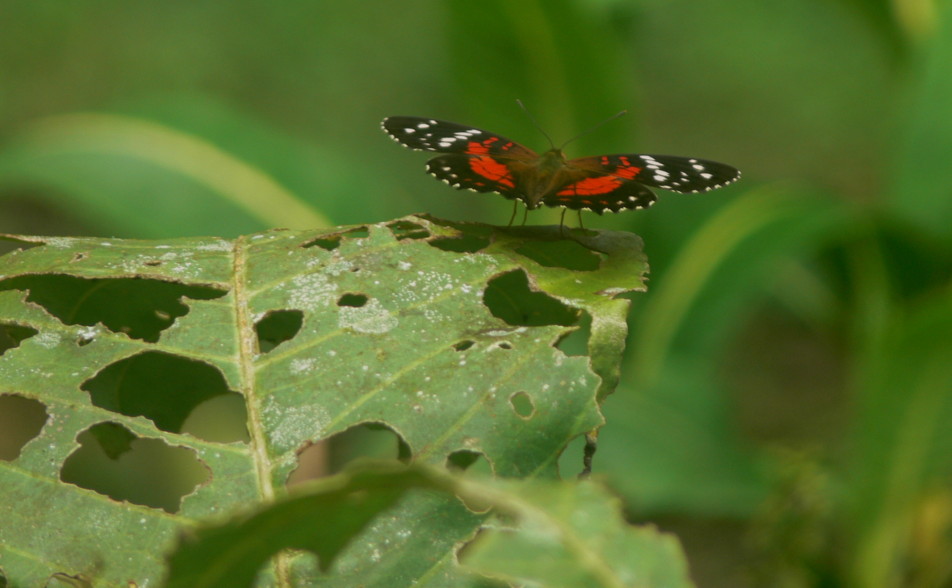
This butterfly at the lodge obviously appreciates a fine timepiece.
Another colorful butterfly.
And another.
A large and colorful jumping spider on a bromiliad.
This frog was croaking from a nearby bromiliad.
A Brown Jacamar catches an insect from mid air.
The smallest, and probably rarest of the potoos is the Rufous Potoo. We would have had no chance of finding this bird without Sandro's keen eye. It stared at us drowsily, but warily with one yellow eye.
An Amazon White-tailed Trogon.
Just outside of our bungalow there was a roosting pair of Cream-colored Woodpeckers. This photo was taken at night from the back deck.

The Black-headed Parrot is exotic in appearance, not to mention colorful and cute.
Sandro told us that there was a trail that led to a Harpy Eagle nest about 3 kilometers away. He said that the eaglet had already fledged but that it was staying nearby it's nest.
We set out eagerly in the first light of dawn on the morning after our arrival at the lodge. The trail was steep and muddy the whole way. Up one hill, down the other side. Over one fallen log, under the next one. On and on, far more than three kilometers.
In my youth it would have been good workout, but with my weak heart it was an excruciating ordeal. I had to rest constantly, and was close to passing out much of the time. We were seeing great birds along the way but I barely noted them in my exhaustion. Some I ignored altogether.
When we finally reached the nest tree, mom and dad and junior were nowhere to be seen. I was bitterly angry and collapsed onto the ground in near despair. Sandro was bright and chipper and quietly slipped off into the jungle.
Several minutes later he was back, motioning for us to follow him. I was so tired that I almost refused to move. He led us for about a hundred yards further into the forest and pointed up into some very tall trees.
I could see nothing at all because it was raining and my glasses were hopelessly fogged up. Sandro took Gary's spotting scope and fixed it onto the bird. Then we took turns looking at the magnificent immature Harpy Eagle. I could not photograph it at all but Gary got a digiscoped image of it.
Young Harpies are nearly pure white and have short crests compared to the adult birds. It was certainly a highlight sighting of my birding career. Thank you Sandro. The long obstacle course back to the lodge took about three and a half hours but I knew I could make it just on the elation of a successful quest. We saw many great birds during our stay in the Ecuadorian Amazon.