Untamed Land

Untamed Land
Untamed Land

Friday, June 17, 2011

Life in Full Flourish

Summer Solstice is almost here. It's a joyous time, here in the land of the midnight sun. After a few weeks of cold, gloomy, and rainy weather, the sun was/is out today, and I was out and about enjoying it.
Alder Flycatcher (above) is a drab empidonax type of flycatcher. Best identified by it's voice, rather than it's looks. They are amoung the last of the breeding birds to arrive, and first to head back south. They come, breed, leave, all in six weeks or two months.
Although they are common while they are here, they stick to cover. Today was the first time I have been able to get photos of a territorial male.

A local news crew was at Westchester Lagoon doing a story about urban birds, and the proliferation of new life amoung the local waterfowl. Mallards were the most conspicuous.
More babies. I must have seen ten different broods today.
A slightly older chick has already learned to beg for bread from picnickers.
I must have seen ten Red-necked Grebe nests as well.
A Red-necked Grebe fishes for it's mate on the nest.
Mew Gulls were very protective of their chicks.
This hungry chick would not leave it's parents in peace.
An adult keeps a watchful eye on it's young.
There was no shortage of Robins along Chester Creek Greenbelt.
Many birds have a brood patch, (an opening in their breast feathers that allows the adults to incubate eggs more effectively) during the breeding season. The brood patch is clearly visible on this Robin.

Thursday, June 16, 2011

Greenwings, 11x14"

Last Summer I photographed this sleeping hen Greater Scaup with a diminutive, hen Green-winged Teal, dozing beside it. They were at Spenard Crossing, here in Anchorage.
A year or two earlier I saw this drake, Green-winged Teal in Chester Creek, a few hundred feet above Spenard Crossing. A mischievious Magpie knocked it off the log moments after I shot this photo. Earlier I was photographing the Magpie as it walked all around me, and when I turned my attention to the duck, it apparently got jealous. Magpies are way smart.
I knew I wanted to incorporate the first two Greenwings into a painting, but I liked this Greenwing's head more than the other drake.
This is the composition that I came up with. It looks totally different than the image I had in my mind. I think I like the water more than the rest of the painting. This painting makes me want to paint more variations on a similar marsh habitat theme
A detail photo of the ducks.

Saturday, June 11, 2011

Bald Eagle Painting etc.

The latest painting is a 16x20" pair of Bald Eagles in a snowstorm. As usual, the actual painting looks so much better, with subtle glazes, colors, and textures that just dont show up in the photo. It still does'nt have a title yet.
Since this is such a short post, I'll include a few photos from Russian Jack Park a few days ago. This, of course, is an American Robin.
I wish I had more interesting subjects to photograph, but these are about the only things in the neighborhood right now. I have'nt even seen a moose since one almost stomped me a few weeks ago while I was out riding my bicycle. It was being chased by two moronic, shopping center security guards in a golf cart. They chased it down the bike path that I was on. By making a sharp turn into the grass, I avoided a collision.
I also managed to get a few photos of a Snowshoe Hare. They are fairly shy, and not all that common in the city.
There is a small population of them in Russian Jack. I dont see them on most of my visits.

Thursday, June 9, 2011

A Celebration of Sunbirds, part 2

My recent trip to Uganda was where I really saw a great diversity of sunbirds. There were far more good photos,(and not so good photos) than I could include in my preliminary trip reports. That's what really inspired these two blog posts, the desire to share some of the photos that did'nt make it in the earlier trip reports.
The above photo of a Collared Sunbird is an example. It was photographed in Entebbe.
The Field Guide to the Birds of East Africa includes 53 species of sunbirds. Only a portion of those species occur in Uganda, and many of them only occur in Western Uganda,(that is the only place in East Africa, not including West Africa). I saw 14 species of sunbird in Uganda.
Along with the challenge of figuring out similar species of male sunbirds, and the near impossible challenge of identifying female sunbirds, there is the added difficulty of trying to work out the identities of immature male sunbirds. Many of them are not even illustrated in the field guides.
In spite of it's blue, rather than green irridescense, I believe that this is an imm. male Collared Sunbird. It was photographed in Fort Portal, Uganda.
This is a very non-descript, and un-sunbird looking, Little Green Sunbird.
Another sunbird that is just as tiny as the Little Green Sunbird, is the Tiny Sunbird. This bird was in Nshogi Camp, in the Bwindi Impenetrable Forest.
Another sunbird in Nshongi, Regal Sunbird. This is the only individual of this species that I saw.
There are several species of double-collared sunbirds. This is a Northern Double-collared Sunbird, in Buhoma Camp, in Bwindi.
One of the most attractive, and most common species of sunbird that we saw were Red-chested Sunbirds. This bird was at the restaurant in Mweya, Queen Elizabeth NP.
Another Red-chested Sunbird at that wonderful restaurant.
My favorite sunbird of the bunch, Scarlet-chested Sunbird. Also at the Mweya Restaurant.
Another shot of the same species at the same place.
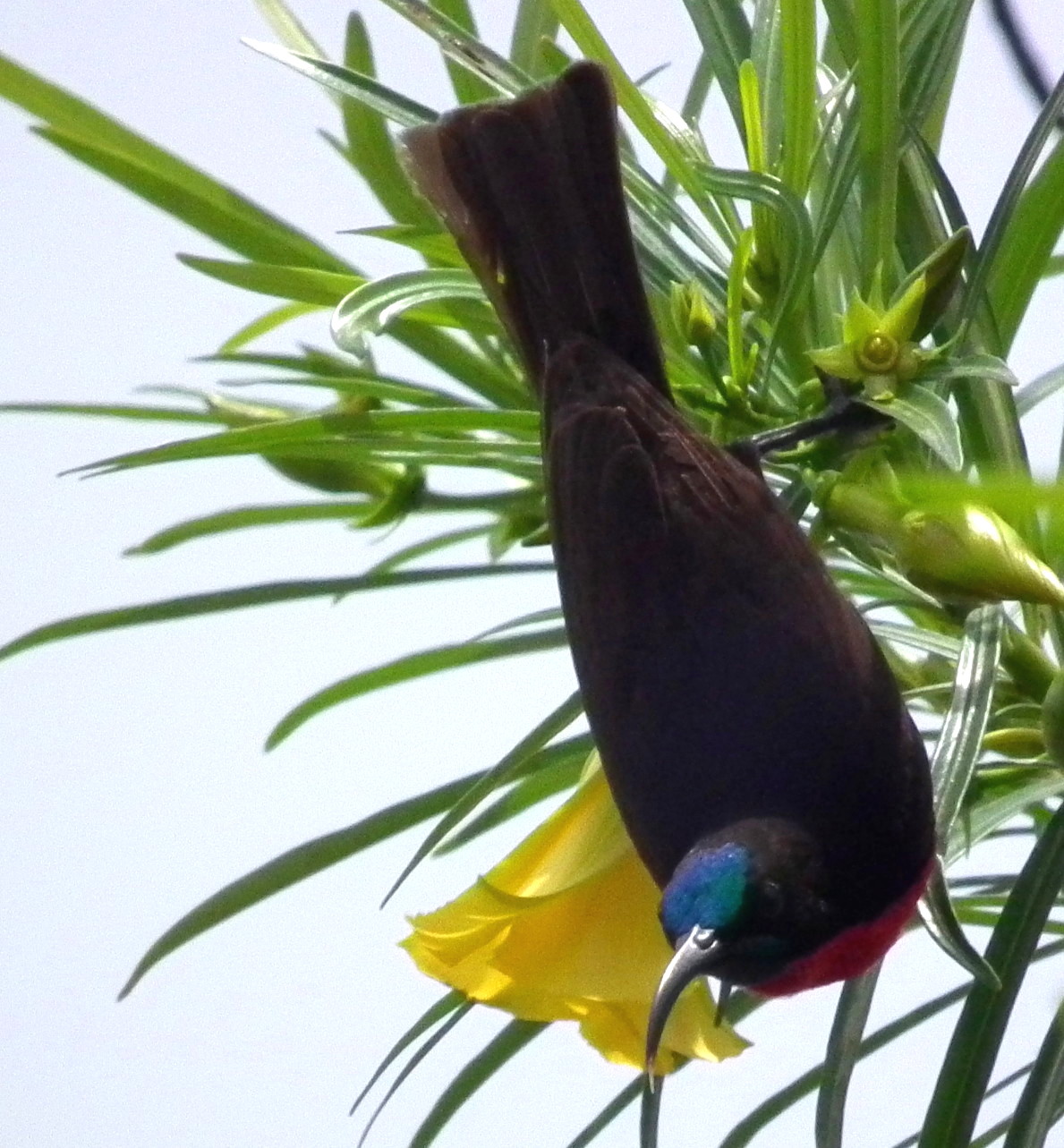
It was a thrill to photograph a pair of Bronze Sunbirds on a Banana flower in Fort Portal.
The first place where I started seeing Bronze Sunbirds was Nshongi. It took me a long time to figure out that this was a female Bronze Sunbird.
Bronze Sunbirds are one of the larger species of sunbird. This magnificent male was in Buhoma, in Bwindi.
Such a cooperative subject deserves a second photo.

Sunday, June 5, 2011

A Celebration of Sunbirds, part 1

Sunbirds are a large family of nectar-sipping birds that occur in South Asia, Indonesia, Africa, and parts of the Middle East. I'm not sure if they range all the way to New Guinea or Australia. My Guide to the Birds of Southeast Asia shows 17 species of sunbird occuring there.
One of them is the Olive-backed Sunbird in the above photo. It is the first sunbird species that I have seen, and I have probably seen more Olive-backed Sunbirds than any other sunbird species. They were all seen in Thailand, where they are very common.
Sunbirds are small with metallic plummage. They look and act like the hummingbirds of the Western Hemisphere. However, they do not hover and their nesting behavior is completely different. Sunbirds build hanging nests like the Olive-backed Sunbird nest above. Both males and females feed the nestlings.
Himmingbirds by contrast, build tiny, cup nests and the male takes no part in building the nest, incubating the eggs, or feeding the young.
This spectacular male, Green-tailed Sunbird was on top of the highest mountain in Thailand, Doi Inthanon. The only other Southeast Asian Sunbird species I have seen is the Ruby-cheeked Sunbird, and the even more spectacular Crimson Sunbird. I have seen several other species which I could not identify.
My Field Guide to the Birds of Southern Africa lists 41 species of sunbird. Many of them are very difficult to distinguish one from another.
The first sunbird I saw in Africa was this glittery, male Malachite Sunbird near Johannesburg, South Africa. It is one of the largest sunbird species.
Female sunbirds are especially difficult to identify. They are drab by comparison to the males. One has to pay attention to habitat, behavior, subtle plummage markings and body proportions. This individual was in the Drakensburg Mountains of South Africa. It is probably a female Malachite Sunbird.
A male Amethyst Sunbird buries it's head in a blossom in Kruger NP.
This was a female sunbird I identified by observing which males it associated with. That's how I figured out that this was a Greater Double-collared Sunbird. She was in the gardens of a lodge at the base of the Drakensburg Mountains.
The male Greater Double-collared Sunbirds were fearless of me, and allowed me to approach closely.
The late afternoon light was nearly perfect. The Red Hot Pokers were in full bloom. There were several GDC Sunbirds along with a few Amethyst Sunbirds visiting the flowers. Only the GDC Sunbirds cooperated for photos, but I could not have asked for better photographic circumstances.
Other sunbirds I saw in South Africa were, Collared Sunbird, and Purple-banded Sunbird. There were more that I could not identify.

Tuesday, May 31, 2011

Arizona, 12x16"

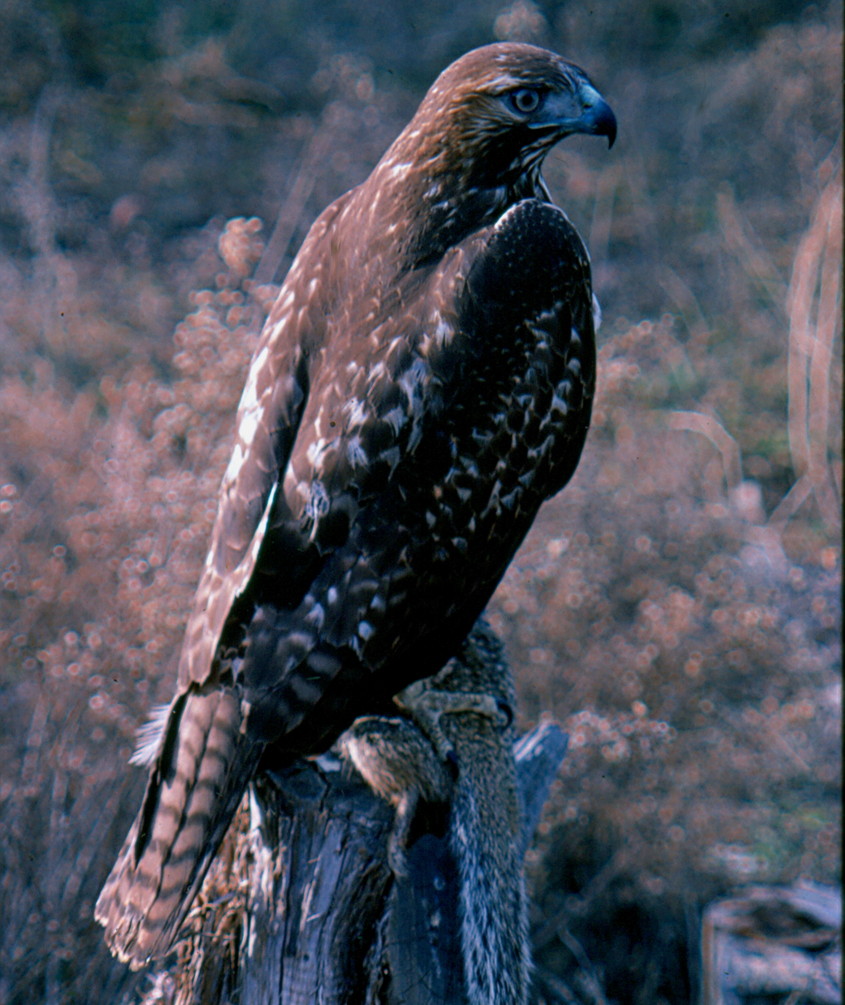
This is what I have been working on for the last several days. It is a Red-tailed Hawk with a Rock Squirrel in it's talons. The title of the 12x16"painting is, Arizona. The reference photos that I used were photos of an imm. Redtail that I rehabilitated when I still lived in Arizona. The actual painting has much richer colors than can be seen in this photo.
Although I was not a licensed wildlife rehabilitator, the Dept. of Game and Fish would often get overwhelmed by the number of injured and orphaned wildlife that people brought to them. That is when they would call me to help out on an emergency basis.
A trapper shot this bird when it pounced on a Gray Fox that was caught in one of his traps. He could easily have left the hawk to die, but he had enough of a conscience to bring it in for treatment.
This was a large, sub-adult female. She planted her talons deep into my flesh when I tried to get her out of the car when she was brought to me. Those sharp daggers sank into my hands and arms like they were marshmallows. OUCH! I raised rats in my shed, and collected fresh roadkill to feed this bird. The Rock Squirrel is roadkill that I tossed into the back of my pick-up and brought home.
This is her on the first day, all menace and fury. In a very short time she tamed down and actually had a very sweet personality. When she was ready to be released, she did not want to go.
Another sub-adult female that I rehabilitated. This was an American Kestrel. She became so tame that she wanted to perch on my shoulder all day like a parrot. When she was not on my shoulder, she would follow me from room to room.
She hated to go outside, but as she matured she became more independent. In a period of about two weeks, she went from fearing the outdoors to sitting by the window and longing to go outside. When she was released, she took off with great enthusiasm and never looked back.
This adult, male Northern Goshawk never tamed down at all. On the day we released it back into the wild it started screaming in excitment. As soon as it flew, a wild Sharp-shinned Hawk darted out of the forest and chased it.
Not a bird that I rehabilitated. Just a nice view of an imm. Townsend's Solitaire from my AZ. days.
One of the local species of warbler in Northern Arizona, Virginia's Warbler. We also had Red-faced Warblers and Painted Redstarts amoung others. I just did'nt manage to bring photos of those beautiful species to Alaska with me.
Hermit Warblers were not local breeders, they only migrated through the area in the early fall.
The most common hummingbird species around Lakeside was the Broad-tailed Hummingbird.