Untamed Land

Untamed Land
Untamed Land

Thursday, June 14, 2012

Yet Another Vagrant

Last winter there was a mini invasion of Eurasian birds. I managed to see the Redwing, Dusky Thrush, and Eurasian Widgeon, but I missed several other things. This summer has seen an invasian of stray birds from more southerly regions. I missed the Great Blue Heron, Great Egret, and Caspian Terns amoung others. I did get the Franklin's Gull last week.
For a few days now, AK Birding has been reporting another new arrival to the state. It has been seen near Westchester Lagoon, so that's where I headed this morning. At Fish Creek I saw the Sandhill Crane and this Moose with a very young calf. I don't know what those two dark slashes on the cow's back are.

The curious calf. I was far enough away, not to have to worry about the protective mother.
Check it out, there's two of them. I can't spend too much time watching them, I've got a vagrant to find.
One of these days I'm really going to get a great shot of an Arctic Tern in flight. This one is not too bad.
Now I have to move along to find my target species.
Although I was too slow on the trigger to get photos, I watched a Bald Eagle snatching baby gulls and ducklings. The adult birds were nearly apoplectic. This young Mallard was safe while it was in close proximity to people.
There were only drake, Green-winged Teals. The hens are still sitting on eggs.
One of the islands in Westchester had a bunch of resting Hudsonian Godwits. Mostly males. The females must also be sitting on eggs.
Alaska has very few beetles. Those that do occur here are very small, like this ladybug on the back of my hand. Tiny, even by ladybug standards. Now it's back to the search for the vagrant.
When I finally made it to the slough at the far end of Westchester Lagoon, Bob Winkler, president of the Matsu Bird Club was already there. He had his scope on the vagrant. Can you tell what it is? It's a relative of the flycatchers, these birds normally do not stray north of extreme Southern Canada. They are usually birds of open country.
A better photograph of a Western Kingbird. I have seen many of these in AZ. and other western states, but this is a new one for my Alaska bird list. This is the bird that first inspired bird expert and author Kenn Kaufman. His field guide of North American Birds is unsurpassed, and his memoir, Kingbird Highway is classic avian literature. I met him and showed him my artwork several years ago in Girdwood, AK. A very pleasant fellow.

Friday, June 8, 2012

A New Painting and Another Vagrant

This is what I've been working on since that Iiwi painting. An 11x14" Golden Eagle. So far it's untitled. I was going for the look of ragged feathers to go with the rugged mountain habitat.  I'm happy with the results.
A report on AK Birding sent me down to the coastal trail again. On Fish Creek I saw this Sandhill Crane. I presume that it's mate is sitting on eggs somewhere nearby right now. This is not the bird I was looking for.
Sandhill Cranes used to nest regularly on Fish Creek, but disappeared several years ago. The reason that they abandoned the area is either because of Human or dog disturbance, or too much eagle depradation on the young.
Last summer they returned, and I believe that they are nesting again although I have seen no young cranes. However, there was an immature crane nearby, late last summer. Maybe it was last year's successful nesting attempt on Fish Creek.

Bald Eagles are nesting within a quarter mile of the cranes. I fear for the survival of this year's young cranes.
This Arctic Tern is also not the bird that I was searching for.
While I was photographing these Greater Scaup, I did'nt even notice the baby Arctic Tern being fed by an adult. I saw mostly drake scaups. Presumably the hens are all sitting on nests somewhere out of sight.
The Canada Geese have a good crop of babies already this sumer.
The flying gull is my target bird. If it were not for the help of a British bird tour group, I would not have seen this distant bird. The Brits graciously allowed me to look through their powerful spotting scopes, so that I could see this Franklin's Gull. Although Franklin's Gulls are common in parts of the lower 48, they are not normally found in Alaska.
I have seen many of them in other places, but it's a new bird to add to my Alask bird list. Now I feel extra special.

Friday, June 1, 2012

A Minor Urban Adventure and a Small Painting

It all started when I checked my e-mails after knocking off from painting for the day. Someone reported seeing a Great Blue Heron at University Lake. Great Blue Herons are abundant throughout most of North America, and I have seen thousands of them from Washington State to Costa Rica..
However, they do not occur in this part of Alaska.
I hastily made a sack dinner, peanut butter sandwich, potato chips, and a granola bar, and threw it in my knapsack with my camera and binocs. It was a decent enough day, and University Lake is only about 3 or 4 miles away. A pleasant bicycle ride from my place. GBH would be a nice addition to my Alaska bird list, so I headed out on my bike, on the quest for the Great Blue Heron.
To avoid city traffic, I rode most of the way along bike paths through Russian Jack Park, along Chester Creek Greenbelt, past Goose Lake, through the University of Alaska campus, past Mosquito Lake, through Alaska Pacific University campus to University Lake. Maybe not the most direct route, but certainly the most scenic.
There is a trail that goes all the way around University Lake. It is a favorite haunt of dog walkers, and they were out in full force that evening. I went around the lake, stopping often to glass the lake and environs from every angle. Mallards, widgeons, C Geese, R N Grebes, Mew Gulls, no heron. Past the lake, there is a small pond that often has waterfowl and shorebirds. I checked it out, swallows and a Lesser Yellowlegs, no heron.
Disappointed, I went back to Mosquito Lake to give it a closer look. Some Ducks and gulls, no heron. By then I was getting hungry so I rode over to Goose Lake to sit at a picnic table and eat my dinner. While I ate my humble meal I carefully glassed the whole lake. It was a pleasure to watch the nesting pair of Pacific Loons who were too far away for photos. No heron on Goose Lake either although the habitat looked ideal.
Finally I gave up and headed home.
Russian Jack Park is one of the few places around here that has a golf course. It is very modest and doubles as a bunny hill for novice skiiers during the winter. While I rode past the golf course there was a Moose helping to keep the grass mowed. The building is the combo golf clubhouse and ski chalet. Since I had not taken a single photo I decided to stop and get this gal's portrait.
Like virtually all urban Moose, this one took little notice of me or other people nearby.

Tired of leaning over, she plopped onto the ground.
This Moose may look a little haggard, but this is a young Moose, born about a year ago. Too young to have a calf of her own.
Today I completed this 10x8" Iiwi. One of a handfull of endemic Hawaiian birds. Most of Hawaii's endemics are critically endangered. Many species have already been driven into extinction. Iiwis are doing better than most. I messed up the background.
You gotta love that beak.

Tuesday, May 29, 2012

The Blonde Bear etc.

This is the latest painting, a blonde, Brown Bear, 11x14". This is another re-make of a painting originally painted in 2005. I disliked the first version so much that I never even photographed it. Something about the basic composition does not quite work. I did my best to fix that.
This is a scan of the painting, rather than a photo. I was trying to make the painting glow with the light of a slightly hazy day. The blue of the water is not quite as bright as what the scan recreated.
Once upon a time I painted with much tighter brush strokes. I can no longer constrain my brush in such a meticulous way. Remember that this photo is bigger than the actual head, which is only about an inch and a half wide in life.

I'll flesh this post out with some older tropical paintings that I have posted before. This is a 12x9" painting of parrots visiting a clay lick in Peru. This was a very popular painting.
An 11x14" painting of a Bay-headed Tanager. I only wish this painting was as popular as the former.
Bay-headed Tanagers live in Central, and northern South America. In life, they are stunningly beautiful. This bird deserves a better effort on my part.
16 x12" Laughing Falcon. I really like the setting for this raptor, but the bird does'nt match the background. I especially messed up it's feet. It is set in Costa Rica, and I did see Laughing Falcons there.
Leaving the Neotropics, this is a 10x8" Cape Sugarbird from South Africa.
A Splendid Fairy Wren from down under. I seriously want to see one of these birds someday, hopefully soon.

Saturday, May 26, 2012

Evolution of the Brown Bear

Back in the day, there was a strong demand for my bear paintings. I painted so many that I reached a level of burnout as I churned out one after another. This was an 8x10" study of a Coastal Brown Bear. It was'nt the worst bear I ever painted, but not quite up to par. I showed it around at a few shows, no interest, and then sent it to a gallery in Fairbanks.
Eventually they sent it back when it did not sell. I figured that I could improve upon it. That is the newer version that you see in the photo above. I toned down the grass and bear with a few glazes, and I refined the bear's facial features. Then I sent it to Homer.
It still did'nt sell. What gives? This is not a bad painting.
When I got the painting back a few days ago, I decided to give it another makeover. More refinements on the bear's head, and I raised it's shoulder hump a little. This photo does not do the painting justice. It rivals any of the small bear paintings that I have done. No more alterations. It's a classic bear study by my standards.
A detail of the bear's head. The real painting actually looks pretty good to me. Much better than the photo indicates.
Right now I'm working on a an 11x14" Brown Bear. We'll see how the new one turns out.

Thursday, May 24, 2012

A Comission and Earthquake Damage

About two weeks ago I was comissioned to do a portrait of a male American Widgeon, based on some excellent photos taken by the client. I was very enthusiastic about finally having a comission, and I dived into the painting too fast. This is the second version. I messed up the first one because I was in such a hurry. The painting is 12x16".
I have not informed the clients that the painting is finished. I'll do that as soon as I post this blog entry. I hope they like it. One thing that really concerned me was whether the drake's pale blue bill would show up against the water behind it. I think it's fine.

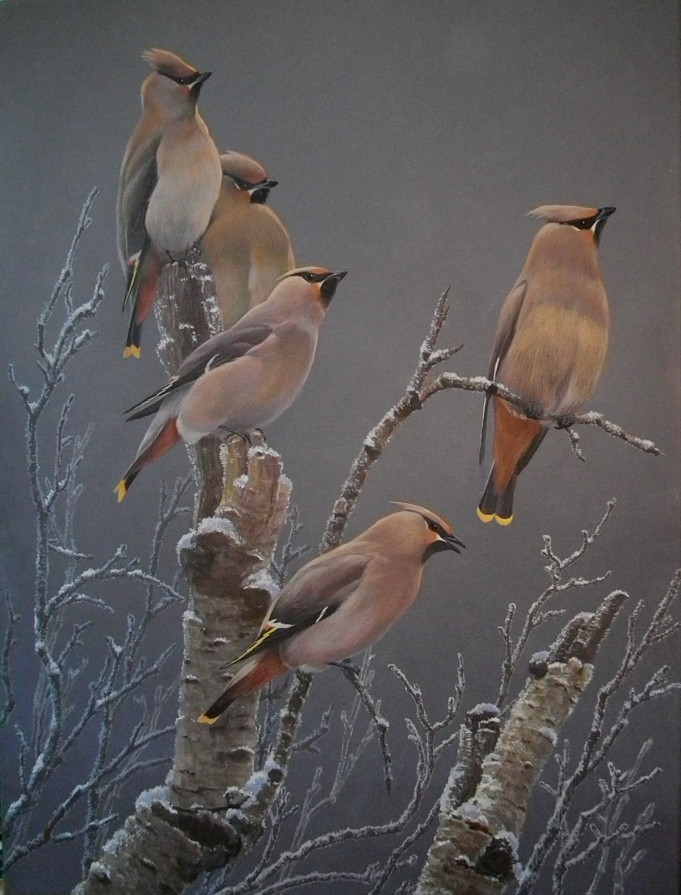
Remember this painting from several months ago? I spent a whole lot of time on this complex piece.
Well about a week ago I was jolted awake in the morning by an earthquake. They are a common occurance here. The only thing that happened was that a stack of paintings leaning against the wall fell over. I righted them, thinking it was no big deal.
This morning, Gary from the Sea Lion Gallery dropped by to pick up some new paintings for his gallery. He specifically mentioned that he was most interested in  the waxwing painting.
I retrieved it and was dismayed to see this 4 inch rip in the canvas. What a bummer. I think that I can repair it to some extent by gluing a swath of canvas onto the back with acrylic medium. Then I can fill the torn canvas with gesso, then paint.
The painting will have a noticeable scar, and it will have to be sold at a substantial discount. I am glad that I had the painting professionally photographed before the damage happened. Nevertheless, it is a lot of labor down  the drain. Boo hoo.

Sunday, May 20, 2012

Two Short Field Trips

On Thursday I went to a place I had never been in south Anchorage called Carrs/gottstein Park with Betty and Aaron. Aaron Bowman is the field trip leader for Anchorage Audubon.
The photo above is the view from the bluff looking south.

We descended from the bluff (on the left) down to the mud flats. The mud flats are much more stable here than they are along the coastal trail. You can barely see Turnagain Arm, (the water in the distance) on the right hand side of the above photo.
Our reason for coming here was to see some newly arrived shorebirds. There were Whimbrels (not in photo) and many Pectoral Sandpipers above. The little guy is a Least Sandpiper. We also saw lots of Bald Eagles, a Northern Harrier, (first of the year), Sandhill Cranes, widgeons, greenwings, mallards, C Geese, gulls, terns, magpies, ravens, and a Yellow-rumped Warbler. Pectoral Sandpipers can be very trusting, like many sandpipers, if you approach them slowly.
Pectoral Sandpipers look very similar to the more widespread Least Sandpiper, but Pectorals are about twice as big as a Least.  Pectorals also have a straight divide between their streaky breast and clean, white belly.
Hudsonian Godwits, Short-billed Dowitchers, and Lesser Yellowlegs stay all Summer to breed, but Pectoral Sandpipers show up, feed like crazy, and move on. They probably breed somewhere close by, but I'm not sure where.
The second short field trip was this evening, (Saturday) at Westchester Lagoon. It was also led by Aaron. The weather was cool and windy, typical Alaska Summer. The trees are finally starting to green up.
The lake was dominated by Greater Scaup. There were a few Lesser Scaup, Mallards, Widgeons, Red-necked grebes, Canada Geese, and a few Buffleheads.  The usual Bald Eagles nesting across the lake.  Less than normal for this time of year.
In the slough below the lake we saw some Lesser Yellowlegs, one Greater Yellowlegs, and a Pectoral Sandpiper. Along the coastal trail were many godwits, Whimbrels, one Wandering Tattler, lots of gulls and Arctic Terns.

Passerines were Hairy Woodpecker, (above) Downy Woodpecker, Starlings, Magpies, Chickadees, and a Yellow-rumped Warbler. Not much to speak of, but typical.