Untamed Land

Untamed Land
Untamed Land

Monday, November 14, 2011

Storkville, Cambodia

A few years ago, I briefly covered both Prek Toal and Angkor Wat in one post. Now I'm going to take the time to do it right. The photo above shows a bunch of nesting Asian Openbill Storks. There are some Painted Storks and other odds and ends scattered around as well. The vegetation gives the impression of solid ground beneath, but it's all inundated by several feet of water.
The day started at 4:00am when we left our hotel in Siem Reep. A short tuk-tuk ride to Chong Neas, a boat ride across part of Tonle Sap Lake, and an arrival to the floating village of Prek toal at about 6:30am. We showed up to the Prek Toal Bird Sanctuary Administrative Building, (floating), only to be told that it opens at 8:00am.
When some sanctuary personnel showed up at 8:00am, they told us that we needed to go to the sanctuary in their boat, with their people. The tour would only last until 1pm. I tried to explain that we were willing to pay extra for a customized, longer tour of the sanctuary. Because of the language barrier, we could not make them understand our desires.
It took half an hour to fill out the paperwork, pay the fees and hop aboard a clunky wooden boat. There was our Sanctuary guide, his son, another boatman, Gary, our tuk-tuk driver and myself. None of the sanctuary people spoke one word of english.
Finally we we off to the sanctuary. I was chomping at the bit in anticipation. Prek Toal is known to be the only place in Southeast Asia to see some critically endangered birds, Greater and Lesser Adjutant Storks, Milky Storks, Grey-headed Fish Eagles, White-backed Falcons, and possibly the near mythical Bengal Flouricon. Many other nifty birds that are hard to find in other places.
Right away we started seeing trees full of Indian, and Little Cormorants. New birds for us. We saw Grey, and Purple Herons, Whiskered Terns and much more.
Chinese Pond Herons are an abundant species that was already very familiar to us. At about this point we started seeing some really awesome birds like Cotton Pygmy Geese, kingfishers, and small bitterns. We wanted to get some photos of these gems so we asked the boatman to stop whenever we saw an interesting bird. He stopped briefly, for every bird, rare or common.
Oriental Darters are another hard to get species in most of Southeast Asia. Four in one tree is a very impressive sight.
I wanted to take more time to try for better photos, but the boatman was running out of patience rapidly. It soon got to the point that he would'nt stop at all for most birds. I tried to get our tuk-tuk driver to explain to the sanctuary guide and boatman that we came a long way to see these birds, and that we wanted to go slow enough to photograph some of them.
We came to a rickety wooden platform, built into a tree. It overlooked the colonies of nesting Asian Openbill, and Painted Storks. They were at a fair distance, and we could not see any of the rarer stork species. A few birds flew closer to us, like the openbills above.
Asian Openbills are much more attractive than their somber African cousins, which are dark brown in color. The African Openbills are much easier to approach.

We found a pair of Brahminy Kites building a nest nearby. We also saw several other raptors, but I'm not sure of their identity.
An adult Painted Stork. At about 10am we started back. The boatman and guide became very impatient like horses that are anxious to get back to the barn. They hardly stopped for anything even though we still had plenty of time. I asked our tuk-tuk driver how to say stop in Cambodian. Whenever we saw a good bird I shouted the word for stop. The boatman and guide would look at me like I was a madman, and ignore me.
One great bird that they did stop for, a sub-adult Grey-headed Fish Eagle. We made it back to the village at about 11:30am. The boatman was proud of his accomplishment, like he won the race in record time. I was nearly apoplectic at that point. They got no tip from me.

Friday, November 11, 2011

Revisiting a Floating Village

In the past several years I have visited floating villages in Thailand, Cambodia, and Peru. It amazes me that people actually build floating houses on foundations of wood or bamboo. They travel by dugout canoes. There are remarkable similarities between these widely scattered cultures. I know that I briefly touched upon the floating village of Prek Toal previously, but it deserves some more detailed attention. The photo above is actually the floating village of Chong Neas on Tonle Sap Lake in Cambodia. You have to start out there, and cross the largest lake in Southeast Asia to reach Prek Toal.
After about two hours in a fast boat, Gary, our tuk tuk driver, (who arranged the boat trip) the boatman, and myself reached the little village of Prek Toal. It is built at the edge of the seasonally flooded forest at the edge of Tonle Sap Lake. The village is high and dry for half the year, but we were there during the time of seasonal flooding. Where the trees are in the background of the photo above is not dry land, it is flooded forest.
Children play in front of their little houses, and they paddle around in boats that are almost too big for them to manage. Do they drink this water? Certainly their raw sewage goes into the water, and I see them swim and fish in this water. One person was even raising crocadiles in a floating pen in the village. Not too sanitary.
Many of the houses have dogs that dutifully guard the home.
I think the red building in the background is the village school.
It was surprising to see a floating Christian church in a Bhuddist land. I dont even remember whether there was a Bhuddist temple in Prek Toal or not.
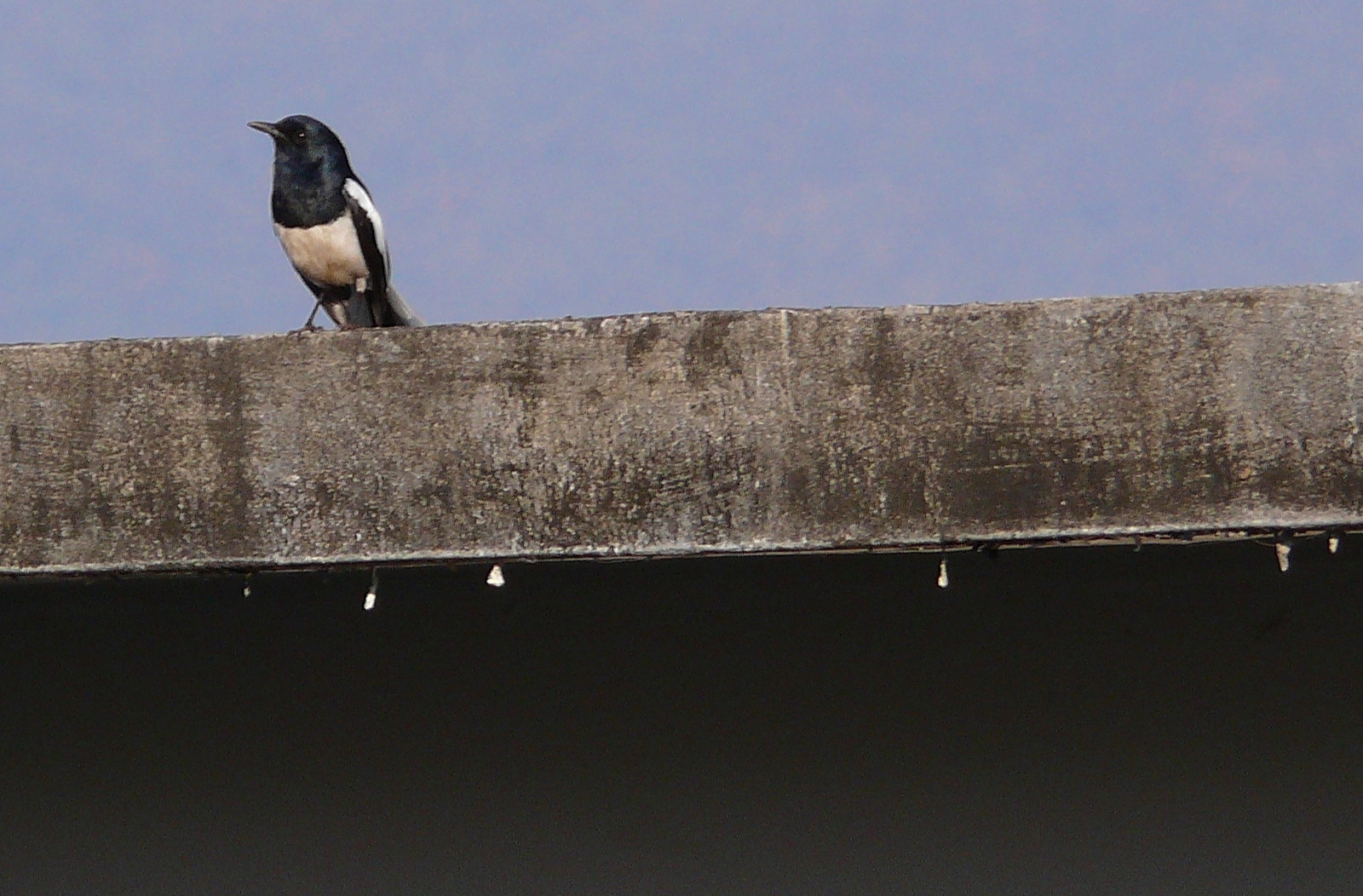
An Oriental Magpie Robin on top of an administrative building of some sort. I think that the little white things hanging under the overhang are cacoons.
Blue-tailed Bee-eaters were my first of 13 species of bee-eater that I have seen so far. Prek Toal is the only place where I saw them.
I was also thrilled to see a Painted Stork fly over the village. It was another first sighting of that species for me.
Brahminy Kite was also a first in the village. The real purpose of our visit to the village was the adjacent Prek Toal Bird Sanctuary nearby. I'll do a post about that little adventure soon.

Sunday, November 6, 2011

Winter White, At Night

The snow started falling again this evening so I grabbed my camera. We got another five or six inches, and the snow is still coming down.
Another look at the forlorn flag in front of my neighbor's apartment.

The trailer park directly out my back window.
See the man clearing the snow off his roof? Either that, or I got a shot of a cat burglar in action.
I went into the vacant land next door and photographed the view looking towards the road out front.

This view almost looks like sand instead of snow. You can still see an impression of my footprints from earlier in the day. I was hoping to get an interesting view of the Russian Orthodox church at night. Unfortunately it was not lighted, and I could'nt see it at all.
So I went out to the highway. You cant really even see the road itself, but this is Alaska's busiest highway, and the only route into the state's interior, and to Canada, and beyond. Not a vehicle in sight.

Winter White

A friendly neighborhood Moose enjoying the fresh snowfall in the lot next to my place.
Lots of places far to the south have gotten snow before we did. Our first snowfall in town was on Oct. 30th. Only an inch or two, but these neighborhood children wasted no time going out and playing in it.
Last night we got about 8" of new snow. My next door neighbor is a proud veteran who always displays the flag. This is the view I saw when I opened the door this morning.
Somebody left their bycicle out in the snow. It will probably be quite awhile before she gets to ride it again. Like next April or May.
A common sight in Winter. Lots of people make extra money plowing out parking lots and driveways.
I walked through the fields next door to take in the sights of early Winter.
Scenes like this are potential inspiration for future paintings. Ink and photo paper are expensive so I'm always way behind on printing out new reference photographs. Especially this year with the terrible economy.
A Black Cottonwood treetrunk.
The days of watching Sunday afternoon football on tv are over for this abandoned couch.
A wide shot of the mountains and the Russian Orthodox Church.

A medium view of the same thing.
A close up of the only remotely interesting building in this whole section of town.
Truth in advertizing, I shot these Moose photos here last winter. I have not seen any Moose in the area lately.
Say goodbye for now.

Wednesday, November 2, 2011

Sitka Blacktail and the Oracle

My latest painting, Sitka Blacktail, 12x9. Sitka Black-tailed Deer are native to Southeast Alaska, and have been introduced to Kodiak Island. They are a small species of deer, and tend to have small antlers. This painting would be considered a large buck. I wanted to capture the look of late afternoon, after the sun has set.
a detail of the head.
Since this is a short post, I'll flesh it out with a brief history lession. My last post was about the Nasca Lines in the Western desert of Peru. There are many archeological sites throughout the barren deserts all along the west coast of Peru.
The principle site in southern Peru is called Pachacamac, about 30 miles south of Lima. It was first occupied about 200 AD, or CE, as they call it now. It was built by the Cuismancu Empire that preceded the Inca Empire by more than a millenium.
Pachacamac is a Huaca, or God, of fire and earthquakes. Huaca is also the generic term for pyramid. The structure above is the huaca, or temple of the sun.

Another complex of eroded buildings shot from the temple of the sun. There are a number of buildings scattered around Pachacamac, and more within Lima's city limits. I cant help but wonder what it all looked like in it's heyday.
Another part of the temple of the sun. I was informed that various parts of human sacrifices were placed inside the alcoves on the right of the photo. I have some skepticism about that.
Way back when the Spanish Conquistadores first arrived in Peru, they first went to Cajamarca, and captured the Inca leader, Atahualpa. Before they held him for ransom, and later murdered him, they questioned him about where all the gold was. Atahualpa told them that Pachacamac was the center of worship for all of South America.
It was the location of the powerful oracle of Pachacamac. The oracle was a thick, wooden staff, carved to look like the Huaca, Pachacamac. It was ancient even back then. Inca priests would consult the oracle for guidance about many issues. I think that maybe Atahualpa hoped that if Pizarro and his men went to Pachacamac in search of gold, the oracle would destroy them.
Pizarro sent a contingent of men to investigate. They were dissapointed by the paltry amount of gold, so they destroyed the place out of habit. Somehow the oracle survived, and now stands in the small museum at Pachacamac. It is not much to look at.
Some Black Vultures keep vigil over a huaca in Lima.
Some alcoves in the wall of a structure in Lima. I imagine they were used for storage.
Some places are better preserved than others. They were built at different times by different cultures.
I dont know what I'm looking at, but it's kind of interesting. Is it a living space? Or for water or food storage?
A nice geometric pattern typical of the region.

This is one of the most important buildings at Pachacamac. I guess it had ceremonial significance.
These are Peruvian Thick-knees. A large, nocturnal species of shorebird that often lives far from water. I know that I have posted about all this before, but I'm trying to use different photos than the first time around. These birds somehow eke out a living in desert that is so barren, there are virtually no plants outside the watered valleys..
I know that I have not posted this particular photo of a Saffron Finch in Lima, next to a huaca.
The race of Blue-black Grassquits in western Peru look quite a bit different than other forms of the same species. This male was on a lawn near the Saffron Finch.